Magnesium · Safety
Magnesium Glycinate Side Effects and Safety
Magnesium glycinate is one of the gentlest supplements you can take. At normal doses, up to 350 mg of elemental magnesium a day, most people notice no side effects at all. In the largest glycinate sleep trial, 93% of participants reported none, and side effects were less common on magnesium than on the placebo (2025 trial).
When side effects do happen, they're almost always in the gut, and they're almost always a sign the dose is too high. The real safety questions are about kidney disease and a handful of medicines. Those are covered below.
Common side effects
| Side effect | How likely | What to do |
|---|---|---|
| Loose stools or diarrhea | Uncommon with glycinate; more likely above 350 mg a day | Lower the dose or split it in two |
| Nausea | Uncommon | Take it with food |
| Stomach cramps or bloating | Uncommon | Lower the dose; check it isn't a buffered product |
Why magnesium causes diarrhea
Magnesium that isn't absorbed stays in your gut and pulls water into the bowel. That's exactly how magnesium laxatives work. Forms like oxide and citrate leave more unabsorbed magnesium behind, which is why they're used for constipation. Glycinate is well absorbed and rarely has this effect, but at high doses even glycinate can.
If a glycinate product upsets your stomach at a normal dose, check the ingredient list for magnesium oxide. Some products are "buffered" with oxide to fit more magnesium into each capsule, and the oxide is usually the culprit. Look for "fully reacted" or "100% chelated" instead.
How much is too much?
The NIH sets the upper limit for magnesium from supplements at 350 mg a day for anyone 9 and older, including during pregnancy and breastfeeding (NIH ODS). That limit is about avoiding diarrhea and stomach upset, not poisoning. Magnesium from food doesn't count toward it, because your body regulates food magnesium well.
Make sure you're counting elemental magnesium, the number on the Supplement Facts panel. "1,000 mg magnesium glycinate" on the front of a bottle is only about 140 mg of magnesium. If you're not sure which number you're looking at, our magnesium label checker will work it out.
Magnesium toxicity
Dangerously high blood magnesium (hypermagnesemia) is rare. In the cases the NIH describes, it involved very large doses of magnesium-containing laxatives or antacids, typically more than 5,000 mg a day, or people whose kidneys couldn't clear the excess. Warning signs include:
- low blood pressure, flushing, nausea and vomiting
- unusual tiredness, or trouble passing urine
- muscle weakness and difficulty breathing
- an irregular heartbeat
These need urgent medical attention. They aren't something you'd expect from a normal glycinate supplement in someone with healthy kidneys.
Who should talk to a doctor first
- People with kidney disease. Healthy kidneys flush out extra magnesium. Damaged kidneys may not, so magnesium can build up even at ordinary doses. This is the most important caution on this page.
- Anyone taking the medicines listed below.
- Pregnant or breastfeeding women taking more than a prenatal vitamin already provides. The 350 mg upper limit still applies.
- Children. Their upper limits are much lower: 65 mg a day for ages 1 to 3 and 110 mg for ages 4 to 8.
Medicines that interact with magnesium
These are the interactions the NIH lists (NIH ODS). If you take any of them, check with your pharmacist.
| Medicine | What happens | What to do |
|---|---|---|
| Tetracycline antibiotics (e.g. doxycycline) and quinolones (e.g. ciprofloxacin) | Magnesium binds to them and stops them being absorbed | Take the antibiotic at least 2 hours before, or 4–6 hours after, magnesium |
| Bisphosphonates for osteoporosis (e.g. alendronate) | Magnesium reduces their absorption | Keep them at least 2 hours apart |
| Loop and thiazide diuretics (e.g. furosemide, hydrochlorothiazide) | They increase the magnesium you lose in urine | Your doctor may want to check your levels |
| Potassium-sparing diuretics (e.g. spironolactone) | They reduce the magnesium you lose | Extra magnesium could build up; ask first |
| Proton pump inhibitors (e.g. omeprazole), taken for more than a year | Long-term use can lower your magnesium | Your doctor may check your levels; don't fix it yourself without asking |
Is it safe to take every day?
Yes, for healthy adults at up to 350 mg a day. Magnesium is a nutrient you need daily anyway, and there's no evidence that steady use at normal doses causes problems in people with healthy kidneys. You don't need to cycle off.
Glycinate compared with other forms
| Form | Gut side effects | Why |
|---|---|---|
| Glycinate | Least likely | Well absorbed; less left in the gut |
| Malate | Gentle | Also well tolerated |
| Citrate | Mild laxative effect | Draws water into the bowel at higher doses |
| Chloride | Moderate | Can irritate some stomachs |
| Oxide | Most likely to cause diarrhea | Poorly absorbed; most stays in the gut |
If you're switching from another form because of stomach trouble, glycinate is the usual choice. Our comparison of the forms has the full picture.
When to stop and get help
Stop taking it and talk to a doctor if diarrhea doesn't settle within a day or two of cutting back, or if you notice any of the toxicity signs above. Seek urgent help for muscle weakness, trouble breathing or an irregular heartbeat.
Questions people ask
Can magnesium glycinate cause diarrhea?
It can at high doses, but much less often than citrate or oxide. If it happens, lower the dose, split it in two, and check the product isn't buffered with magnesium oxide.
Can you take magnesium glycinate every day?
Yes. For healthy adults, up to 350 mg of elemental magnesium a day from supplements is considered safe for daily use.
Who should not take magnesium glycinate?
People with kidney disease, unless their doctor approves. Anyone on tetracycline or quinolone antibiotics, bisphosphonates, diuretics or long-term acid-reflux medicine should check timing or levels with their pharmacist.
Sources
- NIH Office of Dietary Supplements, Magnesium fact sheet for health professionals
- NIH Office of Dietary Supplements, Magnesium fact sheet
- Magnesium bisglycinate and sleep, randomized trial (2025)
We link to the original study wherever we can. Read how we grade evidence and choose products.
More magnesium guides
 Guide
What Is Magnesium Glycinate?
What it is, why it's gentler than other forms, what it's good for and how to read the label.
Read the guide →
 Guide
Magnesium Glycinate Dosage: How Much to Take, and When
200–350 mg of elemental magnesium a day, how many capsules that is, when to take it and the 350 mg limit.
Read the guide →
 Guide
Magnesium Glycinate for Sleep: Does It Work, and How Much Should You Take?
What the 2025 trial really found, the label mistake most people make, and three products worth buying.
Read the guide →
 Comparison
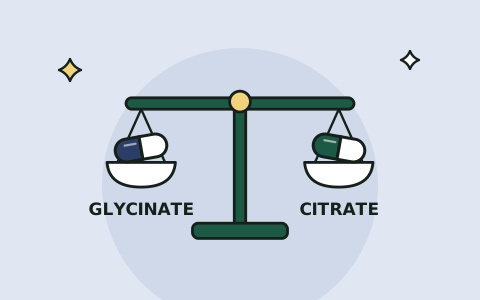
Magnesium Glycinate vs Citrate (and Every Other Form): Which Should You Take?
Glycinate, citrate, threonate, oxide and malate compared on absorption, gut effects and cost.
Read the guide →
 Myths
Creatine and Magnesium Myths, Checked Against the Evidence
Hair loss, kidneys, bloating, sleep, anxiety: 20 common claims, each with a verdict and an evidence grade.
See the verdicts →