Magnesium · Guide
Magnesium Glycinate Dosage: How Much to Take, and When
Most adults take 200 to 350 mg of elemental magnesium a day as glycinate, and that's the range the trials used. Keep supplements at or below 350 mg a day unless your doctor says otherwise, because that's the upper limit the NIH sets for magnesium from supplements (NIH ODS). Food doesn't count toward that limit.
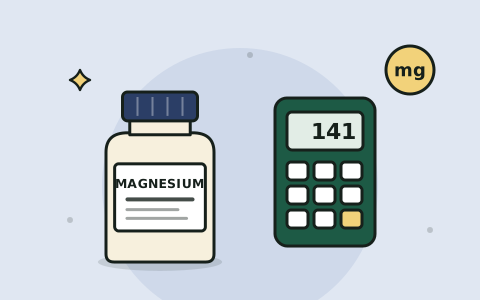
The catch is that "200 mg" means 200 mg of magnesium, not 200 mg of magnesium glycinate. Get that wrong and you'll take about a seventh of the dose you think you're taking.
How much magnesium glycinate per day?
| Your situation | Elemental magnesium a day | Notes |
|---|---|---|
| Topping up a so-so diet | 100–200 mg | Your food already supplies some |
| Sleep | 200–350 mg | The best sleep trial used 250 mg |
| General daily use | 200–350 mg | The most common range on labels |
| Upper limit from supplements | 350 mg | Set by the NIH for adults, including in pregnancy |
| Migraine prevention | Up to 600 mg | Above the limit: only under a doctor's supervision |
| Kidney disease | Ask your doctor first | Your kidneys clear extra magnesium |
How much you need from a supplement depends on what you already eat. The recommended intake from all sources is 310 to 320 mg a day for women and 400 to 420 mg for men (NIH ODS). Nuts, seeds, beans, leafy greens and whole grains are the big food sources. In US surveys, about 48% of people got less than the estimated average requirement from food alone. A supplement is there to close that gap, not to replace it.
Elemental magnesium vs magnesium glycinate
This is the part labels make confusing. Magnesium glycinate is magnesium bound to glycine, and glycine is heavy. Only about 14% of the weight of magnesium glycinate is actual magnesium.
| Label says | What you get |
|---|---|
| "Magnesium (as magnesium bisglycinate) 200 mg" on the Supplement Facts panel | 200 mg of magnesium |
| "Magnesium Glycinate 1,000 mg" on the front | About 140 mg of magnesium |
| "Magnesium Glycinate 400 mg" in a capsule | About 56 mg of magnesium |
Always dose by the Supplement Facts panel. If a product only lists the compound weight, our label checker converts it.
How many capsules is that?
Glycinate capsules often hold somewhere around 50 to 120 mg of elemental magnesium each, which is why many products have a serving of two or more capsules. Count from the panel, not the front:
- If the serving size is 2 capsules and the panel says 200 mg, each capsule is 100 mg.
- With 100 mg capsules, a dose near the trial's 250 mg means two (200 mg) or three (300 mg). Either is fine.
- Powders are usually measured in scoops. Check the serving size on the panel the same way.
When to take it
Timing matters less than taking it consistently.
- For sleep: 30 to 60 minutes before bed, which is what the participants in the 2025 sleep trial did.
- For general use: whenever suits you. Morning, evening or split across both all work.
- If you're taking more than about 200 mg: splitting it into two doses can be easier on the stomach, and the 2025 trial split its 250 mg across two capsules.
With or without food?
Either. Glycinate is gentle enough that most people can take it on an empty stomach. If it bothers you, take it with a meal. There's no need to avoid food with it.
A few things are worth separating from your magnesium by a couple of hours, because magnesium can block their absorption (NIH ODS):
- Tetracycline and quinolone antibiotics, such as doxycycline and ciprofloxacin: take the antibiotic at least 2 hours before, or 4 to 6 hours after, your magnesium.
- Bisphosphonates for osteoporosis, such as alendronate: keep them at least 2 hours apart.
More on these, and on other medicines that change your magnesium levels, in the safety section of what magnesium glycinate is.
How long until it works?
That depends on what you're taking it for. In the sleep trial, most of the improvement showed up within the first two weeks. For a general top-up, there may be nothing you feel at all, because you're correcting a shortfall rather than adding an effect.
Give it four weeks at a steady dose before you decide. If you're taking it for sleep, keep a short note of bedtime, how long it took to fall asleep and how you felt the next day. Without that, it's hard to tell a real effect from a good week.
Taking too much
Above about 350 mg a day from supplements, the first sign is usually loose stools, nausea or stomach cramps. Glycinate causes these less often than other forms, but it isn't immune. If it happens, cut back.
Serious magnesium overdose is rare in people with healthy kidneys and has mostly involved very large doses of magnesium-based laxatives or antacids, often more than 5,000 mg a day (NIH ODS). People with kidney disease are the exception: they can build up magnesium at much lower doses and should only take it if a doctor approves.
A simple routine
- Find the elemental magnesium number on the Supplement Facts panel.
- Start at 200 mg a day for a week to see how your stomach takes it.
- Move up to 250–350 mg if you want, taken in the evening or split in two.
- Keep antibiotics and osteoporosis medicines at least two hours apart from it.
- Judge it after four weeks.
Questions people ask
How much magnesium glycinate should I take for sleep?
The best trial used 250 mg of elemental magnesium a day as bisglycinate, taken before bed. Most people take 200 to 350 mg.
Can I take 400 mg of magnesium glycinate?
If the label means 400 mg of the compound, that's only about 56 mg of magnesium, well within limits. If it means 400 mg of elemental magnesium, that's above the 350 mg upper limit for supplements, so ask your doctor first.
Is it better to take magnesium glycinate in the morning or at night?
For sleep, take it 30 to 60 minutes before bed. For general use, timing doesn't matter much; take it when you'll remember.
Should magnesium glycinate be taken with food?
It doesn't need to be. Glycinate is gentle enough for most people on an empty stomach. If it bothers you, take it with a meal.
Sources
- NIH Office of Dietary Supplements, Magnesium fact sheet for health professionals
- Magnesium bisglycinate and sleep, randomized trial (2025)
We link to the original study wherever we can. Read how we grade evidence and choose products.
More magnesium guides
 Guide
What Is Magnesium Glycinate?
What it is, why it's gentler than other forms, what it's good for and how to read the label.
Read the guide →
 Guide
Magnesium Glycinate for Sleep: Does It Work, and How Much Should You Take?
What the 2025 trial really found, the label mistake most people make, and three products worth buying.
Read the guide →
 Comparison
Magnesium Glycinate vs Citrate (and Every Other Form): Which Should You Take?
Glycinate, citrate, threonate, oxide and malate compared on absorption, gut effects and cost.
Read the guide →
 Myths
Creatine and Magnesium Myths, Checked Against the Evidence
Hair loss, kidneys, bloating, sleep, anxiety: 20 common claims, each with a verdict and an evidence grade.
See the verdicts →