Creatine · Guide
When to Take Creatine: Before or After a Workout?
The best time to take creatine is whenever you'll take it every day. Creatine works by building up in your muscles over weeks, not by giving you a boost on the day you take it, so consistency matters far more than timing. If you want an edge, some small studies suggest taking it close to your workout, particularly just after, may be slightly better. The difference, if there is one, is small.
Why timing matters less than you'd think
Caffeine and pre-workouts work within the hour. Creatine doesn't. A single dose tops up the creatine stored in your muscles a little; the benefit comes from those stores staying full, day after day. Once your muscles are saturated, which takes about a week with a loading phase or three to four weeks without, they stay full as long as you keep taking it (Kreider et al., 2017).
That's why sports nutrition researchers say there's no single best time, and that taking creatine consistently is what counts (Antonio et al., 2021).
Before or after a workout?
| Timing | What the evidence says |
|---|---|
| Shortly after training | Possibly slightly better in small studies |
| Shortly before training | Fine; similar results in most comparisons |
| Morning, away from training | Fine; you'll still saturate your stores |
| Split across the day | Fine; easier on the stomach |
| On rest days | Take it anyway |
The study most often quoted is a small 4-week trial in 19 recreational bodybuilders who took 5 g either just before or just after training (Antonio & Ciccone, 2013). The after-training group came out slightly ahead on muscle gain and bench press strength, but the differences were small and not statistically clear-cut.
The idea behind it makes sense: blood flow to the muscles is higher after exercise, and muscles may take up creatine a little better then. But the effect is small enough that if taking it after training means you'll forget it half the time, it's not worth it.
On rest days
Take it. Your muscles lose about 1 to 2% of their creatine a day whether you train or not, so a rest-day dose keeps stores topped up. Take it whenever suits you, for example with breakfast.
Morning or night?
Either. Creatine isn't a stimulant, so it won't keep you awake, and there's no evidence it works better at a particular time of day. If you train in the evening, taking it after your session is a reasonable default. If you train in the morning, the same applies. If you don't train at a set time, take it with your first meal.
With food or on an empty stomach?
Either works. Taking creatine with a meal that includes carbohydrate and protein may slightly increase how much reaches your muscles, but it isn't necessary. If creatine upsets your stomach, taking it with food usually helps.
What about mixing it with coffee or a pre-workout?
Coffee is fine. Early research suggested caffeine might blunt creatine's effect, but later studies haven't backed that up in any meaningful way. A warm coffee also dissolves creatine better than cold water.
Pre-workouts that already contain creatine often include less than a full 3 to 5 g. If you take one, check the label and top up to 3 to 5 g in total.
A simple routine
- Pick one thing you do every day: breakfast, your morning coffee, your post-workout shake.
- Add 3 to 5 g of creatine monohydrate to it.
- Do it on training days and rest days alike.
- If you miss a day, just carry on. Don't double up.
Our creatine dosage guide covers how much to take, and our creatine calculator works it out from your bodyweight. Wondering whether to load first? See creatine loading phase.
Questions people ask
Is it better to take creatine before or after a workout?
Some small studies suggest just after is slightly better, but the difference is small. Taking it every day matters far more than when.
Should I take creatine on rest days?
Yes. It keeps your muscle stores full. Take it whenever suits you.
Can I take creatine at night?
Yes. It isn't a stimulant, so it won't affect your sleep, and it works the same at any time of day.
Sources
- Antonio & Ciccone 2013, Pre versus post workout creatine (JISSN)
- Antonio et al. 2021, Common questions and misconceptions about creatine (JISSN)
- Kreider et al. 2017, ISSN position stand on creatine safety and efficacy (JISSN)
We link to the original study wherever we can. Read how we grade evidence and choose products.
More creatine guides
 Guide
What Is Creatine? How It Works and What It Does
Where creatine comes from, how it powers short, hard efforts, and what it can and can't do for you.
Read the guide →
 Guide
Creatine Dosage: How Much to Take and How to Take It
3–5 g a day, whether loading is worth it, when to take it, and what to mix it with.
Read the guide →
 Guide
Creatine Loading Phase: Do You Need It?
Loading fills your muscles in a week instead of four. When it's worth it, and how to do it without the stomach upset.
Read the guide →
 Safety
Is Creatine Safe? What the Long-Term Studies Show
Kidneys, liver, hair, cramps and water weight: what the research shows, and who should check with a doctor first.
Read the guide →
 Safety
Creatine and Your Kidneys: What the Research Says
Why creatine raises creatinine on a blood test, what the studies show, and who should avoid it.
Read the guide →
 Safety
Does Creatine Cause Hair Loss? What the Research Actually Shows
The 2009 DHT study behind the worry, the 2025 trial that measured hair directly, and what's still unknown.
Read the guide →
 Guide
Creatine for Women: What the Research Actually Shows
The bulky, bloating and hair-loss worries, what the research shows after 40 and 50, and the dose that works.
Read the guide →
 Guide
Creatine After Menopause: What It Can Do for Women Over 40 and 50
Muscle, bone and walking speed: what two 2-year trials found, and why training is the part that matters.
Read the guide →
 Guide
Creatine for Older Adults: What It Does for Muscle and Strength Over 50
What 20-plus trials in adults over 50 found for muscle, strength, bone and memory, and why training is the part that matters.
Read the guide →
 Guide
Creatine and Your Brain: Does It Really Improve Memory and Focus?
Why the brain is harder to top up than muscle, who the trials say benefits, and the problem with the headline numbers.
Read the guide →
 Guide
Creatine Bloating and Water Weight: Causes and How to Fix It
Why the scale goes up, why your stomach might complain, and seven ways to reduce both.
Read the guide →
 Buying guide
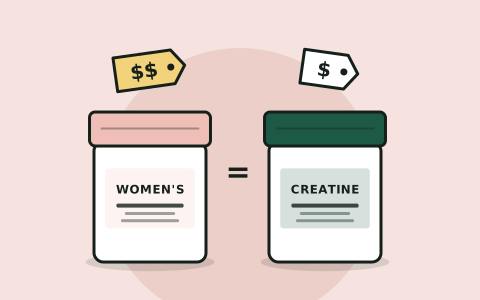
The Best Creatine for Women (and Why Most "Women's" Creatine Isn't Worth the Markup)
Five third-party-checked monohydrates compared on testing and price per 5 g serving.
Read the guide →
 Comparison
The Best Form of Creatine: Monohydrate vs HCl, Micronized and Creapure
Monohydrate, HCl, micronized, Creapure, buffered and gummies, judged on head-to-head trials.
Read the guide →
 Myths
Creatine and Magnesium Myths, Checked Against the Evidence
Hair loss, kidneys, bloating, sleep, anxiety: 20 common claims, each with a verdict and an evidence grade.
See the verdicts →